 JumpstartJiBuy battery the right way
Car battery
How to jumpstart a car safely
The right cable order is simple. The wrong one can hurt you or the car.
Car battery
The right cable order is simple. The wrong one can hurt you or the car.
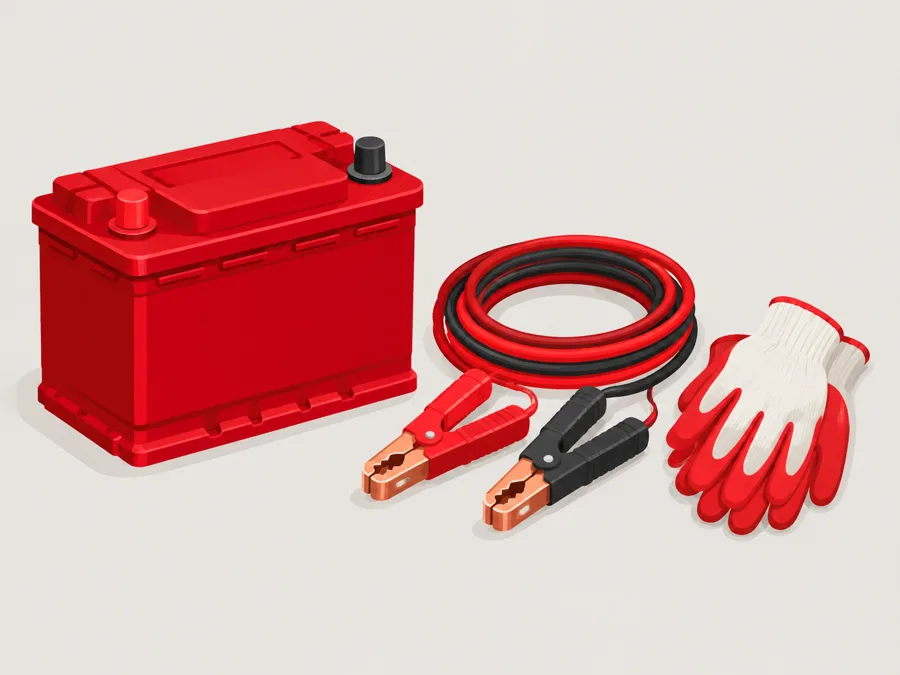
A jumpstart looks simple: two cars, two cables, and the dead one starts. Most of the time it is. But a car battery stores enough energy to cause real harm if the cables go on in the wrong order, and a damaged battery should never be jumped at all. Here is the safe sequence, based on AAA's published jumpstart procedure.
One rule comes before everything else: check your owner's manual. AAA's own guidance starts with "always consult your owner's manual for vehicle-specific instructions." Many cars have designated jump-start points - a positive terminal under the bonnet that is not on the battery itself - and where the manual names those points, use them instead of the battery terminals.
Look at the dead battery first. Cracks, bulging sides, or a rotten-egg smell mean leaking acid and possibly explosive hydrogen gas: that battery needs replacement, not a jump. AAA also warns against jumping a frozen battery or one low on electrolyte - it can rupture or explode. Confirm both cars run 12-volt systems (it is printed on the battery label). If either vehicle is a hybrid or an EV, stop and check its manual first: AAA cautions that most hybrids and EVs carry electronics that can be damaged by jump-starting another car.
The donor should be a running car with a healthy battery of similar or larger size. Put both cars in park or neutral with the handbrake set, switch off both ignitions, and take off rings, watches and any metal jewelry. Switch off headlights, dome lights and the radio, and unplug anything in the 12V socket - a phone charger can be damaged by a voltage spike during the jump.
1. Red clamp to the positive (+) terminal of the dead battery - or to the designated positive jump point if your manual names one.
2. Other red clamp to the positive (+) terminal of the working battery.
3. Black clamp to the negative (-) terminal of the working battery.
4. Last black clamp to a clean, unpainted metal surface on the car with the dead battery, such as a bolt on the engine block - not to the dead battery's negative terminal. The final small spark then happens away from the battery and any fumes.
Before starting, check the cables are clear of belts and fans.
Let the donor car run for three to five minutes. Its alternator pushes a surface charge into the dead battery, which is what makes the start possible. AAA notes that holding the donor's revs slightly above idle can help.
Crank in short bursts of no more than about 20 seconds, with a couple of minutes between attempts. If it cranks slowly, stop and give the donor another five minutes of charging rather than cranking repeatedly. Rapid clicking usually points back to the battery or a poor connection. A single loud click with bright dashboard lights often points to the starter motor instead, and a jump will not fix that.
The most common reason for a failed jump is a poor connection. The clamp teeth must bite into clean, bare metal: even a thin layer of whitish-blue corrosion on the terminals can block the current. Disconnect safely, clean the posts, and try once more. If it still will not start, stop: the real problem may not be the battery at all, and continuing risks damaging both cars' electronics.
Leave the cars connected and running for another three to five minutes, then remove the clamps in the exact reverse order: the ground clamp first, then black from the donor, red from the donor, and red from the started car last. Do not let the clamps touch each other until all four are off.
A jumpstart gets the engine running; it does not fully recharge the battery. A 20-to-30-minute drive with the air conditioner and other heavy loads off lets the alternator put back useful charge, but an older or struggling battery may still not hold that charge for long. The sensible next step is a proper battery test. If the car starts with a jump but dies again after a short drive, the charging system may not be refilling the battery - our post on telling a dead battery from a failed alternator covers that.
JumpstartJi offers 15-minute doorstep battery help in Bandra, Khar, Santacruz and Juhu, 10 AM to 7 PM, Saturday to Thursday. We test the battery first and hand you a printed test report before recommending anything. If the battery is healthy, you keep it - we replace only if needed. Call or WhatsApp 8603 8603 37.
Call or WhatsApp 8603 8603 37, 10 AM to 7 PM, Saturday to Thursday (closed Friday).
Find battery help →Battery or alternator? How to tell which one let you down
Procedure based on AAA’s published jumpstart guides (aaa.com, colorado.aaa.com and mn-ia.aaa.com). This is general guidance - your owner’s manual has the final word for your car.