 JumpstartJiBuy battery the right way
Car battery
Battery or alternator? How to tell which one let you down
Both can stop your car from starting. Here is how to point at the right one.
Car battery
Both can stop your car from starting. Here is how to point at the right one.
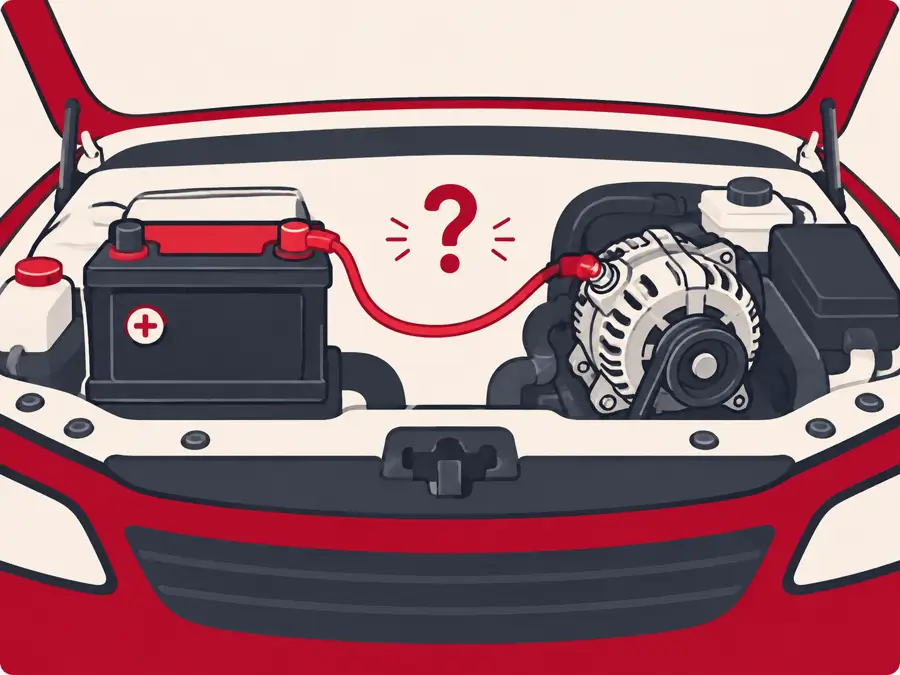
Your car does not start, and someone says "battery". Someone else says "could be the alternator". They are the two usual suspects, and they work as a pair: the battery starts the car, and the alternator charges the battery while the engine runs. When one fails, the symptoms overlap. A few simple checks point you in the right direction.
The battery stores power. It gives the starter motor the big burst of current needed to crank the engine, and it runs your lights and music system when the engine is off.
The alternator is a small generator driven by the engine. Once the car is running, it powers the electrical systems and recharges the battery for the next start. If the alternator stops working, the car runs only on the battery until that charge runs out.
Slow or laboured cranking. The engine turns over slowly, especially in the morning, like it is tired. That is usually the battery struggling to supply enough current, though a worn starter can sound similar.
Click, but no crank. You turn the key and hear a rapid clicking, or a single click, and nothing else. The starter is not getting enough power, most often because of the battery or its connections.
It starts after a jumpstart, then dies again after sitting. If the car runs fine after a jump but will not start the next morning, the battery is not holding charge, or something is draining it while parked.
The battery is old. Batteries wear out with age and use. If yours has crossed a few years of daily driving, suspicion naturally falls on it first.
The car dies while you are driving. A battery problem shows up at start time. If the engine cuts out or the electrics fade while the car is running, the alternator has likely stopped supplying power.
The battery warning light glows while the engine runs. That light on the dashboard is really a charging-system light. On while driving means the battery is not being charged, and that points at the alternator or its belt.
Lights dim and brighten with engine speed. Headlamps that get brighter when you rev and dim at idle suggest the alternator is struggling to keep up.
A new battery keeps dying. If you recently replaced the battery and the car is back to not starting, the battery may again be innocent: something is not charging it, or something is draining it while the car is parked. Both suspicions need a test, starting with the charging system.
The headlamp check. With the engine off, turn on the headlamps. Bright and steady means the battery has reasonable charge. Now start the car (or have someone try). If the lamps dim to almost nothing while cranking, the battery may be weak, but corroded terminals, a loose cable or a worn starter can cause the same dip. If the car starts and the lamps brighten noticeably as the engine revs, the charging system is at least partly alive. Treat this check as a pointer only; a battery test is what confirms it.
The voltmeter check, if you have one. Across the battery terminals with the engine off, a healthy resting battery reads roughly 12.4 to 12.6 volts. With the engine running, the alternator should usually push that to roughly 13.5 to 14.5 volts. One catch: many newer cars vary the charging voltage on purpose to save fuel, so the running reading can dip close to 12 for a while and still be normal. A reading that stays near 12 or below points to the alternator not charging, but a single reading, high or low, is a hint rather than a verdict. A proper test at a workshop settles it.
A jumpstart borrows another battery to get your engine running. If your own battery was simply drained (lights left on, car unused for weeks), a jumpstart plus a good drive may be all you need. But if the alternator has failed, the car will run off the battery for a short while and then die again, sometimes in the middle of the road. So after any jumpstart, the real question is: why was the battery empty? The answer usually decides the fix.
The wrong guess costs money: a new battery you did not need, or a breakdown days later because the alternator was the real problem. JumpstartJi offers 15-minute doorstep battery help in Bandra, Khar, Santacruz and Juhu. We test the battery first and hand you a printed test report before recommending anything. If the battery is healthy, you keep it. We replace only if needed.
Call or WhatsApp 8603 8603 37, 10 AM to 7 PM, Saturday to Thursday (closed Friday).
Find battery help →5 signs your car battery is about to die
Based on JumpstartJi’s doorstep battery-test service. This is general guidance based on standard references, not a remote diagnosis. Symptoms suggest; a test confirms.